 Inside RK
Batch Size 1:
A Systematic Approach
to Custom Cutting
Inside RK
Precision Meets Automation
What starts as a simple wood-based panel is transformed into several components with individual dimensions. Whether intended for a restaurant counter or hotel room furnishings, every part must meet the specific requirements of its intended use. The foundation for this is laid at our production facility in Kleinheubach, where panels are precisely cut to size.
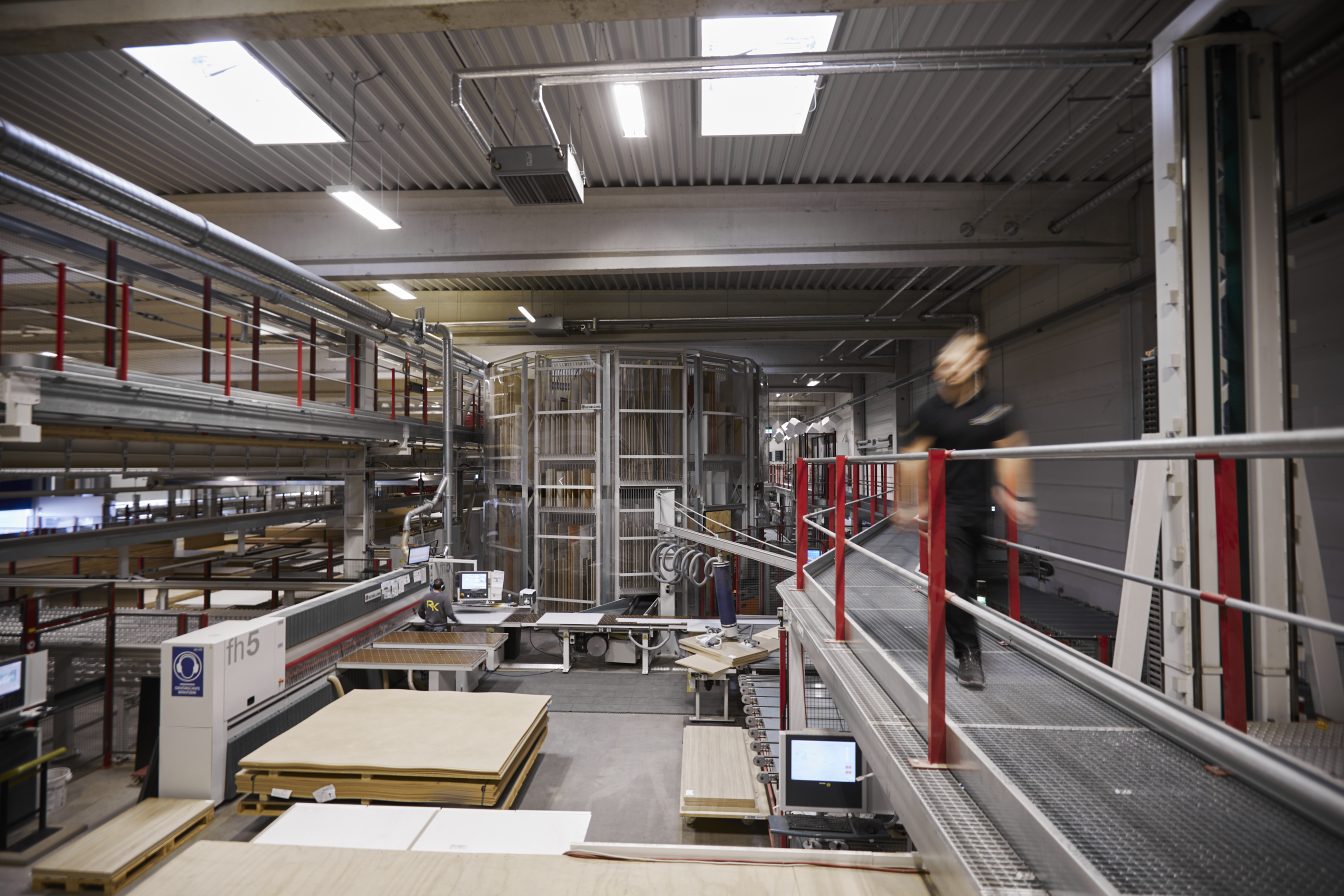
Our facility is equipped with two fully automated LS1 panel saws from IMA Schelling. At high capacity utilization, our entire cutting department can produce up to 5,000 parts per day. This is a demanding task, as individual components often vary in size, shape, or material. Our specialization in batch size 1 manufacturing makes this level of flexibility possible. But what exactly does that mean, and how does automated cutting work?
Every Component Has Its Own Dimensions
When people think of industrial manufacturing, they often picture long production runs of identical products. A machine is set up and then produces as many identical parts as possible. In the interior fit-out industry, however, things often work differently. Even within a single project, numerous components with individual dimensions are required. The challenge is to manufacture this variety efficiently and precisely.
This is where batch size 1 comes in. The principle enables the cost-effective production of individual, custom-made furniture components. Our LS1 systems are designed for this type of industrial manufacturing. However, making this possible requires more than just high-performance machinery. Digital planning is essential, and it begins long before the first cut is made.
The First Cut Begins at the Computer
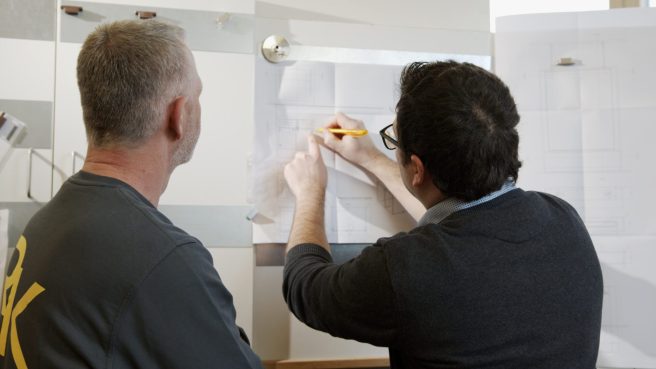
But first, let’s return to our wood-based panel. Even before it reaches the LS1, the components to be produced from it have already been defined. In our design and engineering department, furniture and interior elements are digitally designed as 3D models. The resulting manufacturing data forms the basis for production orders. Our digital production control system is used to prepare and manage the manufacturing processes.
The process known as shift production scheduling determines which components are to be manufactured from which materials. The system then calculates how to arrange them as efficiently as possible on a panel. The result is an optimized cutting plan that specifies each individual cut.
Depending on their dimensions and geometry, up to ten components can be included in a single cutting plan. The goal is to make the best possible use of the available panel surface and minimize material waste. What was previously planned digitally is now put into practice by the LS1.
WHEN THE LS1 TAKES OVER
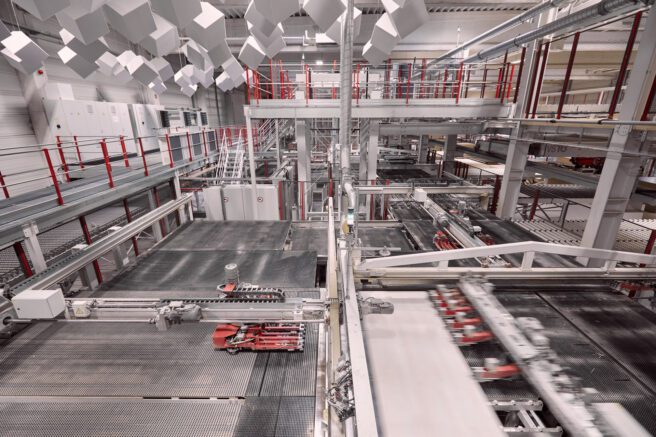
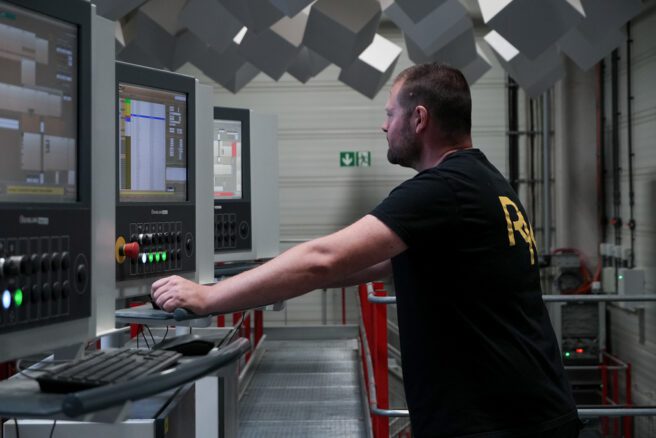
The wood-based panel enters the saw and is processed according to the predefined cutting plan. Our two fully automated LS1 systems operate using a recirculating process. Depending on the requirements, the material is cut from one, two, three, or four sides. The individual processing steps are carried out automatically. Under optimal conditions, a single LS1 can produce up to 3.24 components per minute. Actual output depends on factors such as the dimensions, geometry, and arrangement of the parts on the panel.
For specialty materials, we also use our semi-automatic FH5 panel saw. Assigning materials to the appropriate machines reduces changeover times on the LS1 saws and helps improve overall capacity utilization across our cutting operations.
OUR #TEAMRK KEEPS EVERYTHING ON TRACK
Despite the high level of automation, our machine and equipment operators play a crucial role. They set up the saws, monitor processing operations, and coordinate workflows according to production orders. This requires them to constantly think ahead. Which parts will be needed next? Does the production sequence need to be adjusted? Is the equipment operating as expected?
Technical expertise, experience, and a keen understanding of the machinery are essential. Even minor disruptions can affect downstream workstations. After cutting, the finished parts travel along a conveyor system into an intermediate buffer. From there, they are either transferred to the next processing stage or made available for manual removal.
To maintain an overview of the large number of individual components, the parts are registered and assigned to load carriers. Each part also receives a barcode label. Our production control system makes it possible to track which order each component belongs to and monitor its current processing status.
Individually Designed, Automatically Cut
Our original wood-based panel has now been transformed into several precisely cut components. Each serves a different purpose and will later be used in the corresponding furniture or interior elements.
Our two LS1 systems combine the flexibility of custom manufacturing with the benefits of automated production processes. This is an important prerequisite for efficiently meeting the diverse requirements of our interior fit-out projects in the quick-service restaurant, hospitality, fitness, and other industries.
From Panel to Component
One wood-based panel, many different components. Our two fully automated LS1 systems enable the precise cutting of custom furniture parts based on digitally generated cutting plans. In our video, we show how the process works at our production facility in Kleinheubach.